Choose whole fish when you want the whole-fish presentation and are comfortable separating flesh from the skeleton. Choose a fillet when you want a side cut that is easier to portion and serve. A fillet excludes the backbone, but smaller bones may remain; “fillet” and “boneless” are not interchangeable promises.
At a seafood counter, “whole” also needs a cleaning description. At a restaurant, the same word may describe a fish already cleaned and cooked. Establish the actual form rather than assuming an unprepared animal and a finished dish are equivalent.
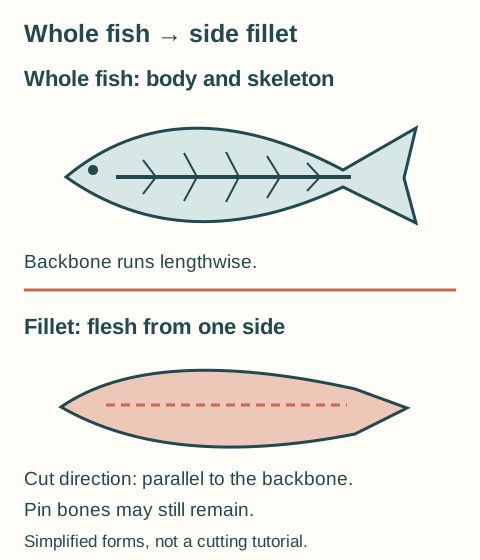
Compare the form before choosing the species
| Detail | Whole-fish serving | Fillet serving |
|---|---|---|
| Presentation | Retains the fish’s overall form | Flesh cut from one side |
| Skeleton | Backbone remains unless separately removed | Backbone removed; smaller bones may remain |
| Portioning | Flesh is separated during preparation or service | Individual portions are easier to identify |
| Skin | Often part of the presentation; check the preparation | Can be skin-on or skinless |
| Advertised weight | Can include non-meat parts | Different product basis; clarify skin and bones |
The comparison explains form, not a taste hierarchy. A well-prepared fillet is not inherently inferior to a whole fish, and a whole fish is not automatically fresher.
Whole, drawn and dressed are different counter labels
NC Sea Grant distinguishes whole fish as landed, drawn fish with the internal organs removed, and dressed fish with additional parts such as the head, tail and fins removed. The exact offered product should still be specified.
A fillet is flesh cut away from the backbone along a side. A steak is a crosswise section, generally from a larger fish, and can contain part of the backbone. A thick piece of fish therefore is not automatically a fillet.
Those distinctions are useful if a recipe asks for a particular form. Replacing a drawn whole fish with individual fillets changes its structure. Replacing a fillet with a steak changes bone handling. Match the form the recipe expects instead of relying on equal weight alone.
Are fillets always boneless?
No. NOAA’s seafood grading document explicitly accounts for bones, including pin bones, in fillet products. Look for a separate boneless or pin-bone-removed description when that matters. Skin-on is another independent attribute: a skin-on fillet can have small bones removed, while a skinless fillet may still need checking.
At a restaurant, the staff may describe how the kitchen prepares and serves the fish. Some whole-fish dishes are presented intact and then separated for the diner; others leave that task at the table. Knowing the service format helps you choose the eating experience you want.
This guide does not promise that a label eliminates every bone. It explains why the cut name alone does not answer the question.
Why equal weights are not equal portions
A whole fish includes parts that do not become the fillet portion. Comparing its weight directly with fillet weight ignores that difference. Usable yield varies with species, size and cleaning method; there is no single percentage that makes every purchase comparable.
You can still use a simple calculation when a supplier provides a realistic yield for the specific product:
Usable weight = purchased weight × usable fraction.
For a purely hypothetical illustration, a two-pound whole fish with an assumed 50% usable fraction would supply one pound of usable flesh. The 50% is an example assumption, not a forecast for your fish. Without a supported yield, retain the uncertainty rather than applying a universal conversion chart.
The same principle applies to price comparisons: a lower posted price per purchased pound is not automatically a lower cost per usable pound. Extra preparation and the intended use of the remaining parts also affect the decision. No live price or fixed savings claim is implied here.
Two situations that favor different choices
For a shared restaurant meal where the presentation matters, a whole fish can be an attractive format if everyone understands the bone-handling task and the service arrangement. The benefit is the presentation and experience, not a guaranteed stronger flavor.
For several individual portions at home, fillets can simplify dividing the ingredient and matching a recipe. Choose the specified skin and bone condition alongside the cut. If the dish needs a whole fish’s shape, however, convenient fillets do not reproduce that structure.
Choose species, cut and preparation as separate decisions. Our fish comparisons help with species; this guide helps with the form you will buy or receive.