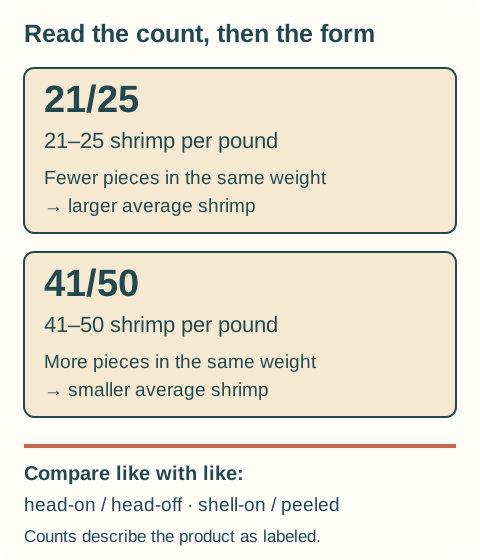
Shrimp size numbers usually describe how many shrimp make up one pound of the labeled product. A 21/25 label means approximately 21–25 shrimp per pound; a lower count means larger individual shrimp. Read the weight unit and product form as well as the number. “Jumbo” alone is a less useful comparison.
The American Shrimp Processors Association explains the count system and notes that descriptive size names vary between suppliers. You do not need to memorize every seller’s chart. The count supplies the comparison that the adjective cannot.
A count chart you can actually use
| Label, if stated per pound | Pieces in one pound | Approximate pieces in half a pound | How to read it |
|---|---|---|---|
| U15 | Fewer than 15 | Not a fixed range | U means under the stated count |
| 16/20 | 16–20 | 8–10 | Larger pieces than 21/25 in the same form |
| 21/25 | 21–25 | About 10–13 | Compare with another count, rather than its size adjective |
| 31/40 | 31–40 | About 15–20 | More individual pieces in the same weight |
| 41/50 | 41–50 | About 20–25 | Smaller average pieces than 21/25 |
The half-pound column is arithmetic, rounded outward to whole pieces: the lower estimate down and the upper estimate up. It is not a guaranteed restaurant portion or a recommendation for how much anyone should eat. Individual shrimp vary, and a package’s grade describes an approximate range.
“U” does not mean exactly that many shrimp. A U15 package can contain fewer than 15 pieces per pound without establishing a lower limit. Nor does a count printed without a unit prove that the unit is a pound: commercial specifications can use kilograms. OCFish’s grading explanation makes that distinction explicit.
Work out pieces from your package label
Use this calculator when the label gives a closed count per pound, such as 21/25. Enter the weight of that same product: a peeled count needs a peeled-product weight, for example. For several packages, use identical counts, forms and package weights. Do not substitute a kilogram count or a weight after peeling or cooking.
The arithmetic is count per pound × weight in pounds × number of packages. Convert ounces to pounds by dividing by 16. The result is an approximate range, not a promise about what you will find when you open the bag. The whole-piece display rounds the lower estimate down and the upper estimate up; this keeps both ends visible rather than using an average.
These examples also work without the calculator:
| Your label and quantity | Calculation | Approximate result |
|---|---|---|
| 21/25; one 8 oz package | 8 ÷ 16 = 0.5 lb; 21–25 × 0.5 | 10.5–12.5 pieces by weight; whole-piece display 10–13 |
| 16/20; two 1 lb packages | 16–20 × 1 × 2 | 32–40 pieces across both packages |
| Target 24 pieces of 21/25 | 24 ÷ 25 to 24 ÷ 21 lb | About 0.96–1.143 lb, or 15.36–18.286 oz |
For the inverse calculation, divide your target by the higher count for the lower weight, then by the lower count for the higher weight. Decimal results are rounded for display, and individual shrimp vary. Count actual pieces if the number matters; the calculated weight cannot guarantee it.
Why two equal counts can still be different purchases
The weight basis matters. Head-on, headless shell-on and peeled shrimp are different product forms. A pound that includes heads and shells is not a pound of peeled meat. Compare like with like before concluding that two labels promise the same amount of ready-to-use seafood.
For example, suppose one bag says “21/25, headless shell-on” and another says “21/25, peeled and deveined.” Both numbers describe their respective labeled products. The second bag also describes work already done. A single count number does not cancel out that difference.
Check these four details together:
- Count and unit: pieces per pound or another weight basis.
- Head: head-on or headless.
- Shell: shell-on, easy-peel, peeled or tail-on.
- Cooking state: raw or cooked.
Frozen versus fresh is another attribute. It does not replace any of those four. Likewise, deveined does not necessarily mean that the shell has been completely removed; read the full description.
Choosing for a particular dish
Start with the job each piece needs to do. For an appetizer where each shrimp is picked up separately, the individual piece size is useful information. For a pasta dish distributed across several plates, the number of pieces can be just as useful. Neither use establishes a universal “best” count.
As an illustrative planning exercise, a pound of 16/20 shrimp gives fewer, larger pieces to distribute than a pound of 41/50 in the same form. If you want a particular number of shrimp on each plate, do the count calculation before buying. If your recipe specifies a count and product form, follow both rather than substituting a word such as “large.”
At a restaurant, an advertised piece count is different from a purchase grade. “Six shrimp” describes six pieces; “16/20 shrimp” describes the size grade. A menu might provide only one of those details. Do not infer the missing one.
The shortest reliable label check
Find the count, confirm its unit, then match the product form. Use words such as colossal, jumbo and medium as the seller’s description, not as a universal conversion table. That approach lets you compare packages, plan pieces and understand a seafood menu without turning a variable naming system into a false precision.