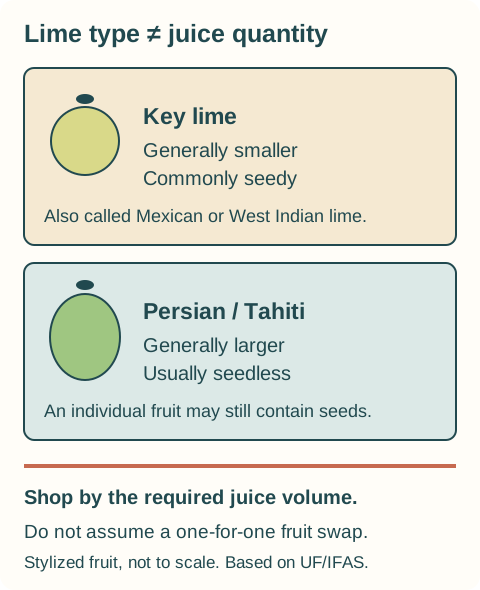
Key limes and Persian limes are different types of lime. Key limes are generally smaller and seedier, with a distinctive aroma; Persian limes, also called Tahiti limes, are larger and usually seedless. Both supply acidic juice. The useful buying distinction is fruit type, seeds and usable juice—not a universal rule that one must be sweeter or more sour in every dish.
For a recipe specifying Key lime juice, start by finding that product. If you plan to substitute another lime, use the recipe author’s guidance rather than replacing a fixed number of fruits one-for-one.
Compare the fruit
UF/IFAS’s Key lime description and its Tahiti lime description provide these botanical reference points. Individual fruit and selections vary, so use the descriptions to understand a label rather than identify every fruit by appearance alone.
| Feature | Key lime | Persian/Tahiti lime |
|---|---|---|
| Other useful name | Mexican or West Indian lime | Tahiti lime |
| Typical form | Small, round to oval | Larger, oval |
| UF reference dimensions | About 1½–2 inches in diameter | About 2¼–2¾ inches long |
| Seeds | Commonly contains numerous seeds | Usually seedless; some conditions can produce a few |
| Mature peel | Greenish yellow to yellow | Green at maturity, becoming yellow before dropping |
| Juice and aroma | Juicy, highly acidic, distinctive aroma | Acidic juice with good flavor and aroma |
Notice that the dimensions describe different measurements: diameter for Key lime and length for Persian lime. They are not a mathematical juice-yield comparison. You cannot calculate exactly how many fruits a pie requires from that table.
Are Key limes more acidic?
Flavor descriptions often compress several things into “more tart”: acidity, aroma, sweetness and how the fruit tastes in a particular recipe. These do not provide a dependable universal ranking for every purchased fruit or packaged juice.
The university descriptions establish that both are acidic, and that Key lime has a distinctive aroma. They support a practical distinction without a promise that a specific batch will taste more sour than another. A finished pie also contains sweetened milk, eggs, crust and topping; the fruit alone does not predict the whole dessert.
If the flavor distinction is central to a recipe, follow a recipe developed for the juice you have. This guide does not claim a tested baking substitution or provide an untested recipe.
Fresh fruit versus bottled juice
For fresh fruit, budget for the work of juicing and separating seeds. Smaller fruit can require more individual pieces and handling than you first expect. Purchase by the quantity of juice your recipe requires rather than assuming that “six limes” means the same thing for both types.
For a bottle, read the full product label. Check whether it is lime juice, juice from concentrate, a blended product, or a sweetened beverage mixer. Those are meaningful differences even when the front label has a lime illustration.
If a recipe specifies juice, a drink mixer with added sweetener is a different ingredient. Likewise, a bottle cannot supply fresh zest when a recipe separately requests zest. Treat juice and peel requirements as separate shopping decisions.
Does Key lime mean Florida-grown?
No. The common name does not identify where a particular fruit was harvested. UF/IFAS notes very limited commercial Key lime production in Florida and describes international production. Its US lime supply overview also explains the importance of imported Persian/Tahiti limes.
For a Florida souvenir or a locally sourced dessert, inspect the claim you actually care about: where the fruit grew, where the juice was processed, or where the pie was made. A product can satisfy one of these without satisfying all three.
A shopping checklist
- Read the requested type. “Key lime juice” is more specific than “lime juice.”
- Measure the amount needed. Use juice volume rather than a fruit-count swap.
- Plan for seeds and zest. Whole fruit and a juice bottle solve different tasks.
- Check the bottle’s ingredients. Juice and sweetened mixer are different products.
- Verify origin separately. A lime’s name is not its country-of-origin label.
If you are choosing dessert on a trip rather than shopping for ingredients, our Key lime pie guide focuses on crust, filling, topping and serving format. Those choices often make the more immediate difference to the slice you order.